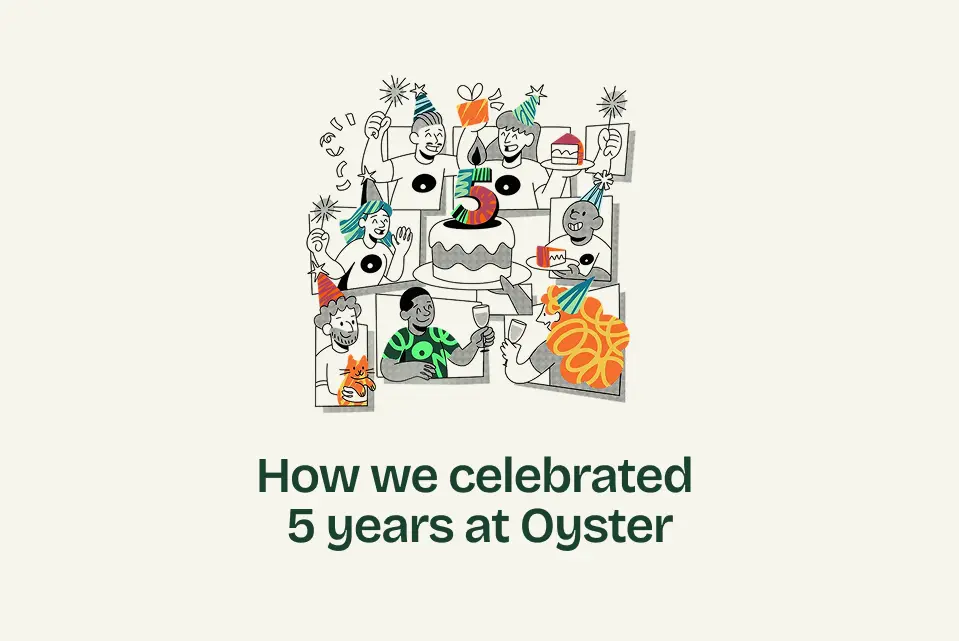
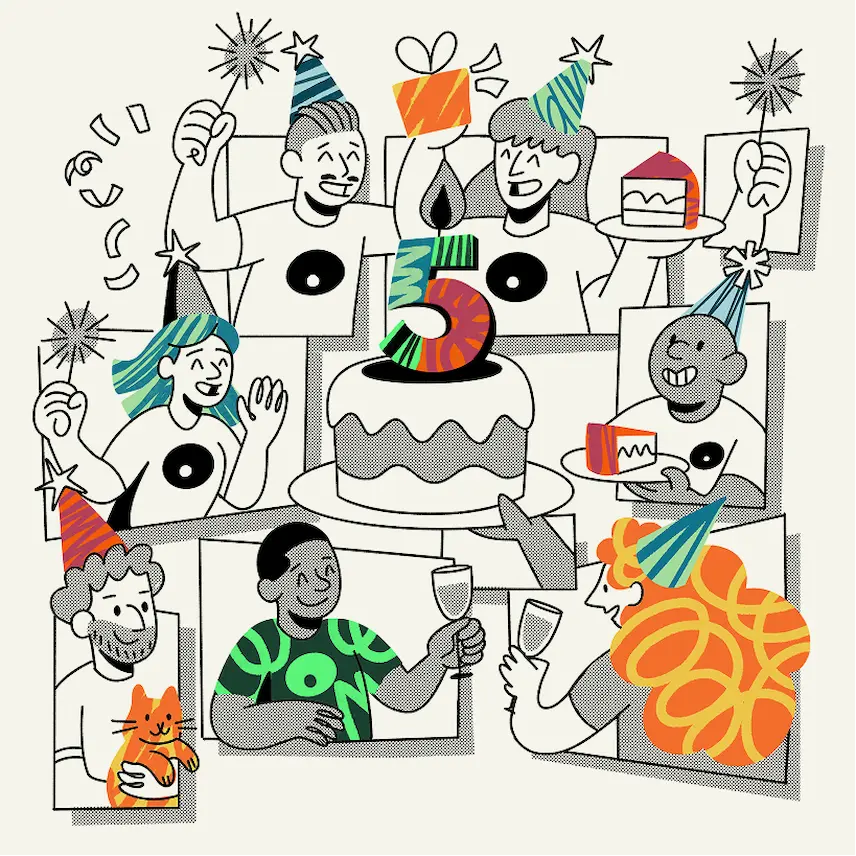
Last month, we ran a synchronous and asynchronous event to throw Oyster a 5th birthday party - here’s what we did and learnt, and how you can do the same.
There’s a simple reason that we paused to celebrate this milestone: to create space for joy. We wanted to give ourselves room to breathe, look back at where we started, and recognise what we’ve built together. Not as a strategy exercise; not as a deck. Just a company of people who’ve done something hard and meaningful, all together, and will continue to do so for years to come.
We were deliberate about keeping KPIs out of it. The measure that mattered was whether joy showed up. It did, in the best places. Our company Slack filled with nostalgia, favourite stories, and (over)usage of the custom designed ‘oyster_is_5_gif’ Slack emoji. The Zoom chat was buzzing with so much chat that it was almost hard to keep up.
That clarity of purpose made our choices easier. If something made the experience more playful, human, or inclusive, it was in. If it added polish but took the air out of the room, it was out. We leaned into the feeling of an actual birthday, not a corporate anniversary. We close the story over slides, and colour over corporate.
In the early days conversation, we dropped having a deck entirely, and just listened as some of our earliest team spoke about our first customers, about selling a dream while the product was still catching up, and how we supported those customers when resources were tight. Honesty landed better than any visual could. A custom birthday song, made by an Oyster with a passion for music production, became the most requested link of the day and a source of joy that kept the celebration going long after the call ended.
We ensured that the birthday party was in conversations across Oyster in the month leading up to it through a company-wide swag design competition. Anyone could enter - some used AI to produce their designs, while others sketched by hand. Once the committee behind the party made a shortlist, we launched a vote live at the All-Hands before the party, and let the team decide what swag was the winner. It was light lift, fundamentally fun, and it quietly built ownership so people arrived already invested in the moment.
We had thirteen entries, one hundred and thirty two votes, and a very enthusiastic comment section. It did exactly what we needed it to do.
Because this was about our shared story, we made it cross‑functional by design. Leaders and long‑tenured teammates from around the business shaped the content and then showed up to tell it. In the People team, we provided the structure and support, but it was teams across the business who filled that structure with memories. That mix made the event feel like Oyster’s voice, not one team’s broadcast.
The format stayed light and varied on purpose. We opened with a live word cloud asking what makes Oyster special. One of our team pulled together a video where we showed the faces of all of the Oysters who have been with us for 5 years - and we surprised them with personalised words from our CEO about each one of them. We listened to early days stories with no slides to hide behind, then closed the loop on the swag competition by announcing the winner (which was tight - only 1 vote separated first and second place!). A live best dressed vote followed, because people had turned up in everything from party clothes to their best costumes. The winner was our General Counsel in a banana costume, after a tightly fought battle for the top spot against our Senior Learning Manager. Later, a conversation with the C-Team members who’ve been here from the start gave us insights into what it was like to lead from so early on. We wrapped with a fifteen‑minute quiz on Oyster and Oysters. It was fast, friendly, and more competitive than anyone expected - and well supported by our tooling, which kept everything moving quickly and smoothly.
If I was to share two choices in the live event that really made a difference, it would be these:
- We switched format often. People don’t drift into spectator mode when the rhythm keeps changing. We used interactive wordmaps to open, kept the energy high in the middle with the best dressed vote, and closed with everyone joining the quiz. We alternated between using slides to support stories, and having slides, to keep the team engaged and focused on the real spotlight: the people.
- We empowered our host to follow the energy. That permission turned a fun idea into a great moment when the best dressed vote became a spontaneous dance‑off between the top two. It was joyful and entirely unplanned, which is why it worked.
On the day, we kept the scaffolding gentle and let participation do the work. Alongside the live event, we ran a light Slack campaign so the birthday spirit could be felt wherever people were working. We invited a handful of long‑tenured Oysters from different parts of the business to share stories in our shoutout Slack channel, and they carried the thread through the day. The effect was simple and lovely: a timeline of our culture told by the people who built it. For anyone who wanted to join the wider celebration, we shared prompts and assets to make posting externally easy without being prescriptive. It kept everything on‑brand and human, which is the balance we care about.
If I could bottle up what worked for next time, it would be separating our celebration from OKRs and KPIs so people could show up as humans first. Using an hour of company time is objectively expensive, and as a result, it can be hard to make space for something that isn’t critical. But focusing on fun and joy meant that people felt more connected to the company, and that brings a huge amount of business value of its own.
I also would strongly recommend building at least one co‑creation mechanic in to your plans to warm up participation. The swag competition brought a conversation topic, and a space for people to play around with their creativity. It made the celebration everyone’s celebration, not just the organising team’s party. Then follow that through by figuring out the right voices to amplify, and quieting your own. The organiser doesn’t need to be front and centre - I’m sure there are many people who have no idea that I ran the event. We put the people who remember what year one felt like at the centre.
We also learned a timing lesson. In the final month of a busy Q3, asking people to step away from delivery for something with no direct business purpose is a big ask, even when the outcome is connection. Framing helped. The light build‑up helped. Next time we’ll run it in the first month of a quarter rather than the last, which should reduce clashes with deadlines and let more people be fully present.
For those building similar moments, here’s the short version of our “why” and “how.” Start by naming the feeling you want to create and let it be your filter. Design for play, not polish. Invite cross‑functional voices to shape and tell the story so it truly belongs to everyone. Offer small, easy paths in before, during, and after, and keep the centre of gravity in community, not content. Finally, remember that joy scales. A playful song, a word cloud, a vote, a story told without slides. None of it is heavy to produce, and all of it creates a more engaged company.

.avif)






.webp)


.webp)
.webp)