With the shift to remote and distributed work, companies are increasingly looking beyond borders for talent, especially for specialized skills. In countries like Spain, this search is met with a substantial talent pool, evidenced by a recent unemployment rate of 10.0% among the workforce aged 15 and over.
One hiring destination that's garnered a lot of buzz in recent years is Spain. What makes this sun-drenched, Southern European nation such a hot talent market for employers, and an attractive home base for international tech talent? Whether you're a People professional, talent leader, hiring manager, or business executive looking to expand into Spain, here's an overview of what the Spanish market has to offer.
Why hire in Spain
Why should Spain top your global hiring list? The country delivers four key advantages: a thriving tech ecosystem, an international talent pool, business-friendly laws, and significantly lower costs than other European markets.
Spain's tech ecosystem is booming
"The tech startup ecosystem is starting to take off. I love building out my network with so many diverse techies." —Ryan Newell, Oyster employee in Barcelona
Spain is home to a growing tech ecosystem—not just the established tech hubs in Barcelona and Madrid, but also emerging hubs in cities like Valencia, Malaga, and Bilbao. The search giant Google, for instance, opened a cybersecurity center in Malaga in 2022, with a planned investment of $650 million over five years.
The numbers tell the story. Over 80% of seed and Series A rounds in 2020 included international investors. According to Dealroom's Spain tech ecosystem report:
- Enterprise value: €93 billion combined value of Spanish startups in 2023
- Investment volume: €4.7 billion raised in 2021, €4 billion in 2022
- Global ranking: 6th in Europe, 16th worldwide for total investment in 2022
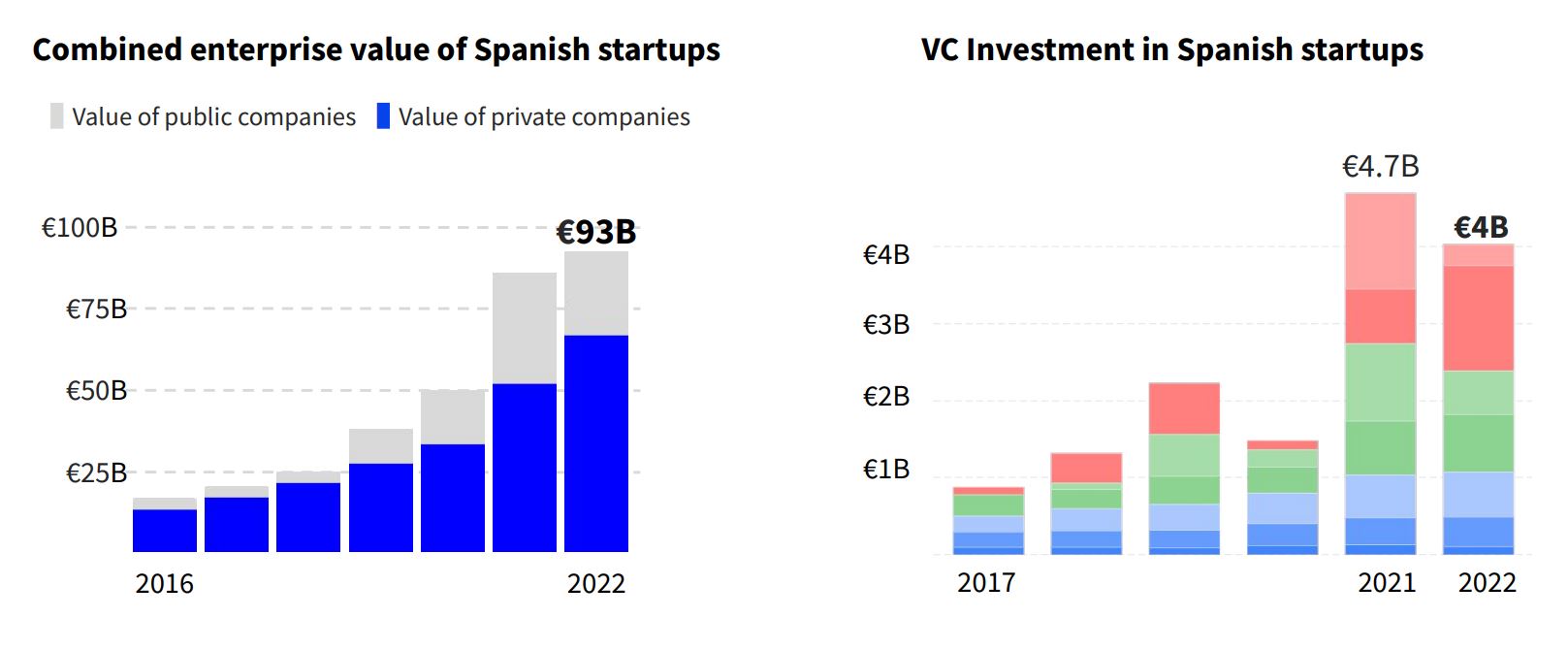 Source: Dealroom.co
The talent pipeline runs deep. Spain's top-notch technical universities rank highly for engineering and technology programs. Graduates gain excellent on-the-job training at Spanish and international tech companies, including unicorns like Glovo, Cabify, Idealista, and Jobandtalent.
Bottom line? You'll find an abundance of highly skilled, experienced tech talent ready to join your team.
Spain's growing international talent pool
Here's what makes Spain different: it's not just about local talent. The country has become a magnet for international professionals, creating a diverse, multilingual workforce.
The digital nomad visa program accelerated this trend, attracting skilled workers with global perspectives and cross-cultural collaboration skills.
Major tech companies recognize this advantage—from Google's cybersecurity center in Malaga to Amazon's expanded operations in Madrid and Barcelona. This international presence creates a virtuous cycle: global companies attract international talent, which strengthens the local ecosystem, which attracts more companies. For employers, this means access to professionals who combine local market knowledge with international experience.
Spain is an attractive destination for skilled workers
"From skiing to surfing, from nature to culture, from food to wine—Spain is an amazing country to explore." —Heleen Lodewykx, Oyster employee in Madrid
What draws international talent to Spain? Three key factors make the country irresistible:
- Cost of living: Almost 20% lower than the U.K.
- Housing costs: €700-€800 for a 50-square-meter Madrid apartment vs. double that in Paris
- Quality of life: Mediterranean climate with 3,000 hours of sunshine annually
Spain also offers a comprehensive public healthcare system, in addition to affordable private options. Finally, the Spanish digital nomad visa has also attracted top tech talent from around the world.
What to know about hiring in Spain
Before you start recruiting, familiarize yourself with Spain's employment basics:
- Working hours: 40 hours/week maximum, 9 hours/day limit, 80 hours annual overtime cap
- Minimum wage: €1,080 per month (€15,120 annually with 14 payments)
- Notice period: 15 working days maximum by law
- Paid time off: 23 days minimum, including two continuous weeks
- Parental leave: 16 weeks for each parent
- Severance: 20 days' salary per year of service
Special considerations: Employees in Spain are entitled to 13th and 14th month salaries in June and December, although it can be prorated and paid out in 12 monthly payments. Parental leave is funded by the social security system, although there are some eligibility requirements.
To learn more about the intricacies involved, be sure to check out our detailed guide to hiring in Spain as well as this helpful resource on employee benefits in Spain.
How Spain compares to other European markets
Your CFO asks: "Why Spain over Berlin or Amsterdam?" Here's your answer.
Traditional hubs like London and Berlin are saturated. Spain offers something different: deep technical expertise without the premium pricing.
The combination of skilled talent, favorable business environment, and sustainable costs creates advantages for companies willing to think beyond conventional markets.
Consider the talent density: Barcelona and Madrid rival any European tech hub for engineering excellence, while emerging centers like Valencia and Bilbao offer untapped pools of skilled professionals. Unlike saturated markets where competition drives salaries skyward and turnover rates soar, Spain provides access to loyal, highly educated talent without the bidding wars.
The business case extends beyond talent availability. Operating costs—from office space to employer contributions—run significantly lower than Northern European counterparts. Yet this isn't about cutting corners. Spain's robust infrastructure, EU membership, and strategic time zone position make it ideal for serving both European and global markets. Companies report that teams in Spain deliver the same caliber of work as those in pricier hubs, with the added benefits of cultural alignment with Latin American markets and strong English proficiency among tech professionals.
Favorable labor laws and lower costs
"The new startup law by the Spanish government has made things easier for tech companies." —Pedro Torrecillas, CEO and Cofounder, Circular
Spain's new Startup Law (December 2022) transformed the business landscape. Key benefits include:
- Residency access: Easier Spanish residency for foreign talent
- Tax benefits: Startup-friendly tax incentives
- Stock options: Delayed taxation until liquidity events, plus stock option grants vs. phantom shares
Companies looking to hire in Spain will also find that local labor laws often work in their favor. For instance, the notice period in Spain is only 15 days, which means a candidate can start working for your company within three weeks. Similarly, the process of letting someone go is also relatively easy, usually with severance pay of 20 days' salary per year of service; however, if a dismissal is declared unfair by a court, the statutory compensation amounts to 33 days' wages for each year of service.
Finally, labor costs in Spain are significantly lower than in neighboring countries. For instance, according to local market data from Figures, the average salary for a junior front-end developer in the U.K. is €47,000, whereas the average compensation for the same role in Barcelona would be €33,000.
How much does it cost to hire employees in Spain?
"The localized pay approach is the easiest to implement because you start with salaries in the location you know, and then convert them to salaries in other locations using a location factor. But it's not a perfect solution because you miss out on local market specificities. That's why we really recommend you use local market data." —Virgile Raingeard, CEO and Cofounder, Figures
Found your ideal candidate? Now comes the compensation question. Your approach depends on your company's philosophy: location-based or location-agnostic pay.
For location-based approaches, consider whether you'll benchmark by city, country, or cost of living factors.
Next, how can you tell what would be considered a good salary in Spain? It's helpful to research local market rates, so you have some idea about typical Spanish salaries for the role you're trying to fill. This kind of data can be hard to find, but Figures is a good place to start for data on European markets. You can use their global salary converter to see what a particular role in one city would earn in another city based on the cost of labor and the cost of living differentials.
Once you have the salary figured out, you need to consider additional expenses such as taxes and social security contributions. Use Oyster's compensation calculator tool to get an estimate of the costs, as well as a detailed breakdown, so that you can be fully informed before you proceed with making an offer.
How to hire and pay an employee in Spain
Let's say you have your candidate and you're ready to hire them. What next? How do you legally hire someone in another country? There are a few different routes you can take.
Set up an entity in Spain
One possibility is to set up a legal entity in the country. With this option, your company retains full control of employment contracts, running payroll, providing benefits, and more. However, setting up an entity can be quite expensive, to the tune of tens of thousands of dollars, and require you to navigate various local bureaucratic challenges. You'll need to become thoroughly familiar with Spanish labor laws and tax regulations—for instance, knowing that an employee with multiple fixed-term contracts can become a permanent employee after 24 months of work within a 30-month period—as well as hire lawyers, accountants, and benefits providers to make sure things are done in compliance with local laws. This level of effort and investment upfront isn't usually worthwhile if you're only going to be hiring a few employees in Spain.
Use an EOR or PEO
Another option is to use an employer of record (EOR) in Spain. This is a third-party organization that acts as the legal employer of the candidate, and takes care of contracts, payroll, taxes, compliance, and various HR functions. In exchange for a fee, the team member then provides services to your company while being legally employed by the EOR. This is a quick and easy way to hire legally in Spain without opening an entity there.
An alternative to an EOR is a professional employer organization (PEO) that acts as a co-employer along with your company. In this model, your company and the PEO have shared liability for employing the individual. The company looks after the operational aspects of the employer-employee relationship, while the PEO typically handles the outsourced HR-related tasks.
Use a global employment platform
A global employment platform (GEP), like Oyster, is a cloud-based People Ops software solution that companies can use to hire and onboard talent across borders, manage local payroll in multiple currencies, offer localized benefits and equity, all while ensuring local compliance. A GEP like Oyster has legal entities or partners in every country where it operates, including legal and tax experts with local, country-specific knowledge. By layering a software solution on top of HR infrastructure and deep local knowledge, a GEP automates and streamlines global hiring in one intuitive, user-friendly platform. Instead of relying on a patchwork of EORs and PEOs, you can manage your global workforce in one place and ensure a smooth and consistent employee experience across countries and continents.
Simplify hiring in Spain with Oyster
For more information about how to source talent in Spain, how to compensate fairly in the Spanish market, and how to hire compliantly, check out our webinar on hiring in Spain with expert advice from Oyster, Figures, and Circular.
Or if you've already found your dream candidate in Spain, reach out to us anytime to learn how you can quickly and compliantly bring them aboard with Oyster.
.webp) About Oyster
About Oyster
Oyster is a global employment platform designed to enable visionary HR leaders to find, engage, pay, manage, develop, and take care of a thriving distributed workforce. Oyster lets growing companies give valued international team members the experience they deserve, without the usual headaches and expense.
Oyster enables hiring anywhere in the world—with reliable, compliant payroll, and great local benefits and perks.